
How TrailView models look
TrailView draws many small models: animals, trees, plants, rocks, benches and other objects. All of them have one style, "soft low-poly". This page says what the style is and why we keep it. The bytes of a model file and the triangle budget of each kind are in the model contract.
The style
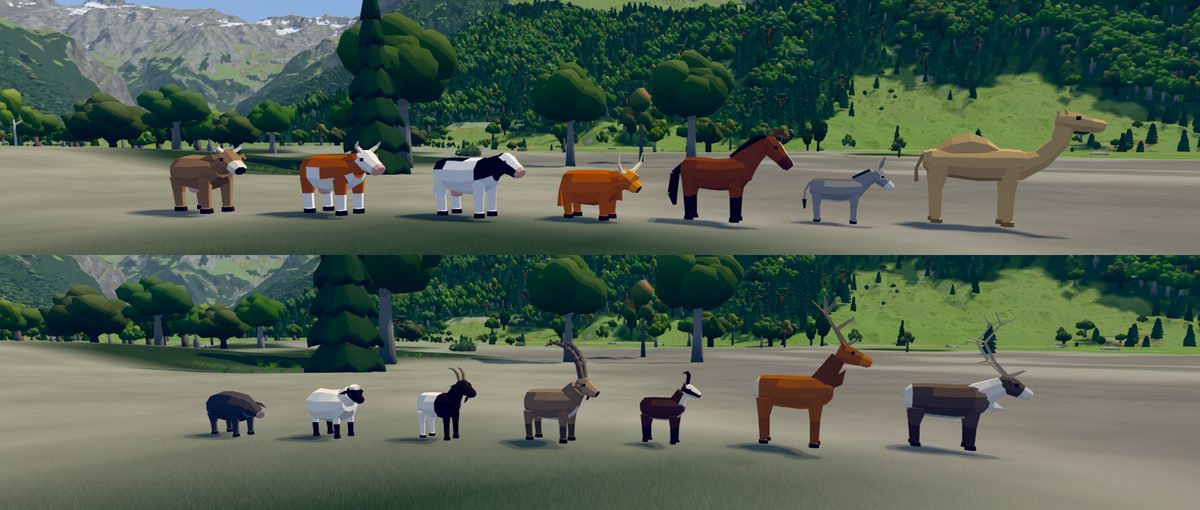
A model is low in detail and looks like a model from a game. It is friendly and never odd. A rider sees it for a moment, at the side of a trail, so its shape must read at once.
- Round shapes. An animal's body is a skin through rings of 8 to 12 sides. Each face has one
flat colour and one normal, so the facets show and the light gives the shape. Trees and plants are smooth: see Trees and Plants.
- Clear outlines. A model reads from the side and from above. Legs, ears, horns and tails stand
out from the body. A detail that a rider cannot see at 10 m does not get a triangle.
- Friendly proportions. An animal has a slightly large head with eyes and a pale muzzle, short
sturdy legs and a round body. The proportions come from the real species; the style only rounds and softens them.
- Few colours. A coat has two or three colours in large areas: a back, a belly, a face, patches
with clear edges. Many small colour changes look like noise at a distance.
Why we make every model in code
We make all models ourselves, in TypeScript. We do not ship models from asset packs or from image-to-3-D tools, even with a free licence. A model from another source has another style, and two sources never agree. Packs and photos are only references.
The animals use one shared kit (sculpt.ts), which has few parts:
- a skin through rings, with a separate reach above and below the middle, a pitch and a
squareness, for bodies, necks, heads and legs;
- a leaf, a flat diamond, for ears, beards and short tails;
- a chain of bars for horns, antlers and tails.
Each face of a part turns away from a point inside the part, so no model needs a hand-made winding order. The animals share one more layer, a four-legged body (quadruped.ts) that a breed fills with its numbers.
Tiers: one build, two levels of detail
Each model builds its near tier and its far tier from the same code. The far tier uses fewer sides and leaves out fine details such as eyes and udders. So the outline and the colour areas stay the same when an animal moves from one tier to the other. For an animal, the near tier ends at 150 m. Past it, an animal is only a few pixels tall.

Poses and coats
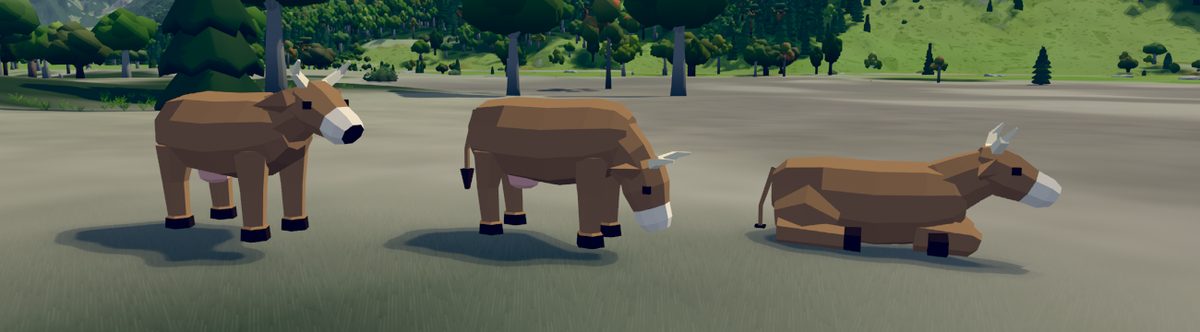
An animal has two or three poses: it stands, it grazes, or it lies. A herd mixes them, so a group looks alive. A breed has one to four coats, and most animals of a group wear the first coat.
Trees
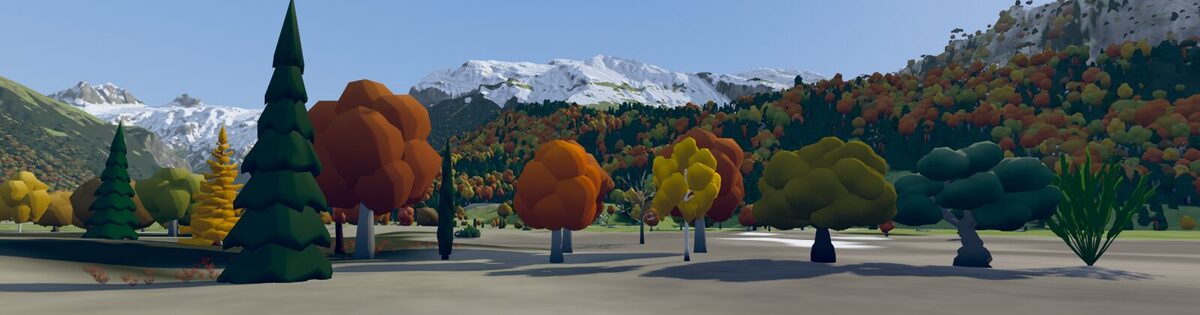
Trees fill the screen, so their crowns have smooth light, not facets. Faceted crowns looked flat and cheap in a forest. The trees have a builder of their own (trees.ts); a species file in trees/ gives its numbers, colours and features.
- The species shows in the outline. A crown is many soft lumps or needle pads on visible limbs,
in the outline of the species: the flat pads of a pine, the flame of a cypress, the drooping sprays of a larch, the rods of a broom.
- Flowers and fruit are shapes. Blossom, berries, cones and catkins are small modelled
clusters, not painted spots.
- A bare crown is a tree. In winter every twig grows from a branch and every branch from a
limb, at each tier.
- Each tier keeps the outline. The far tiers keep the same limbs and crown, with fewer parts.
Plants
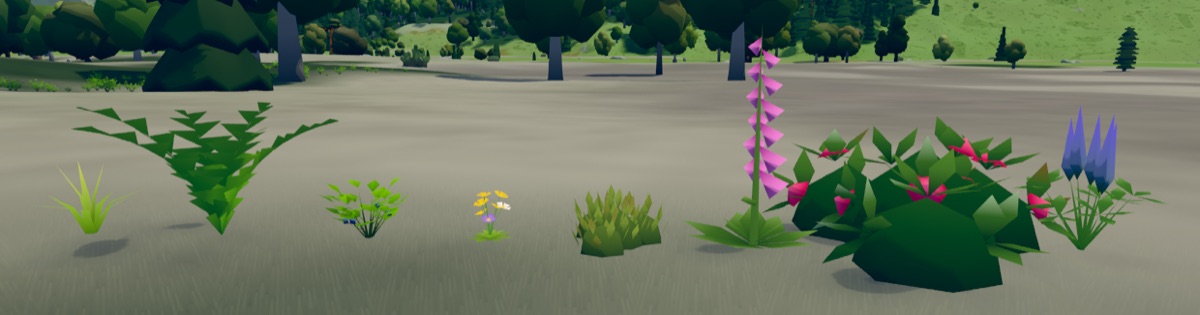
Plants stand near the eye in large numbers, so they keep the smooth light of the trees. Most are thin leaves and blades, which have no body to facet; the fleshy cacti and spurges are smooth too. Each plant is a file in plants/ that builds its three shapes in each season with the parts of plant-shape.ts: blades, kites, round stems and soft cushions.
- The species shows in the outline. The shuttlecock of a fern, the cupped flowers on bowed
stalks of a meadow flower, the thick pads of a prickly pear.
- Flowers, berries and seed heads are shapes, on stems, not painted spots.
- A bush stands on a soft cushion, and its leaves light as one round dome.
- A plant that dies back is not there. A plant file builds no model for a season in which it
has died back, and the engine draws nothing for it then.
- The ground gives the colour. Most ground plants take much of their colour from the ground
under them, so a meadow of tufts reads as the meadow. A flowering plant keeps more of its own, so its flowers show.
Objects
Benches, lamps, masts and the other built objects are not round: a plank is a box and a pole is a tube. They keep the style through their parts and their proportions.
- Each part is a real part. A bench is slats on a frame, a table is planks on legs, a wall is
as thick as a wall. One board that stands for five planks looks cheap.
- Parts meet. A wire ends in a clamp, an arm grows out of its pole, a cable lies on its
rollers. A gap between two parts that belong together looks like a fault.
- No two faces lie in one plane over each other. Such faces flicker at a distance.
- A few materials. Timber in two tones, stone in three, dark iron, and one accent: the brown
insulators of a railway mast, the red cap of a lighthouse, the brass spout of a fountain.
- Light is part of the model. A lamp's glass, a lantern and a fire glow at night.
- A far stage where it pays. A model that stands in large numbers, as a street lamp, has a far
stage with the same outline. A railway mast, its upper wire and its droppers draw only near the eye: farther away a mast is thinner than a pixel, and only the contact wire draws.
A town has two street lamps. An old quarter, where houses cover a third of the ground, has lanterns; every other street and every main road has the modern lamp.
Houses
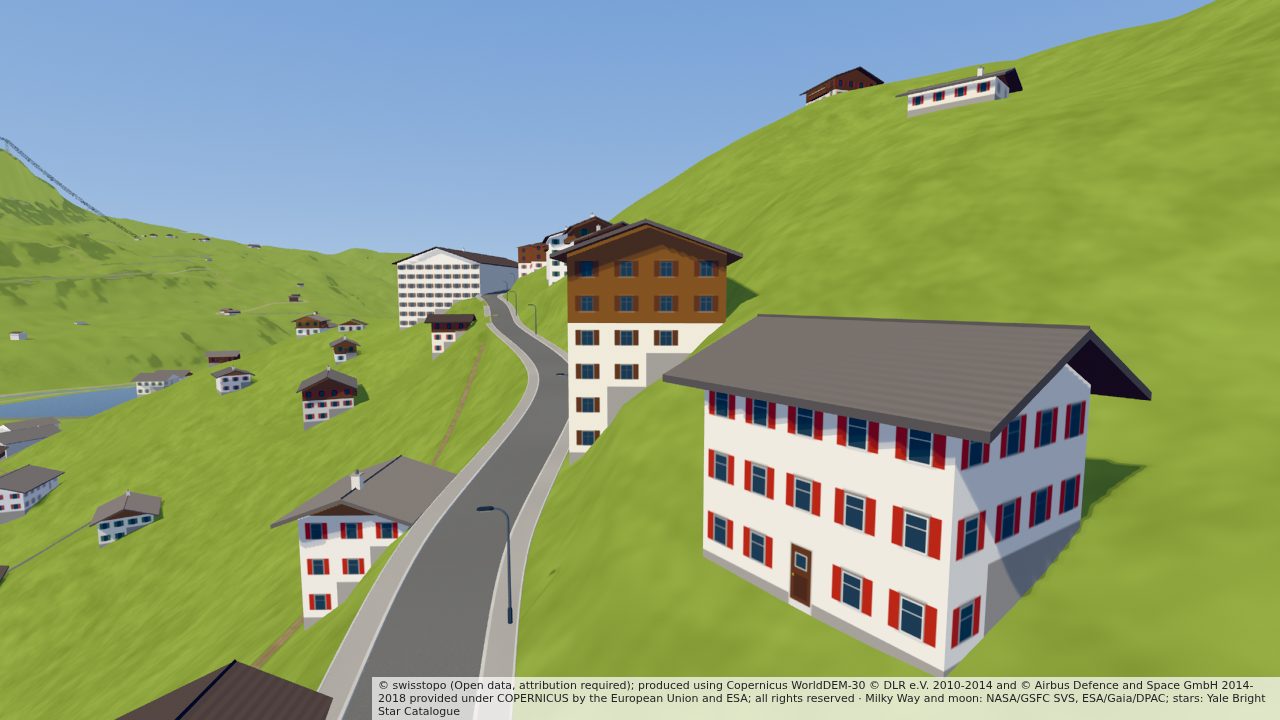
A house comes from a footprint, a style and a seed. A style is a data file with a few numbers and colours, so a region gets its own look without code, and a hundred styles stay cheap.
- A house fits its hill. A real house on a slope is as tall to the valley as the ground falls.
The valley side shows more storeys with windows, down to the ground, over a stone base. A tall blank base looks like a tower, and a house cut into the hill looks buried.
- The door stands on the ground. People walk in where the ground is, at any storey.
- Fine detail is paint with soft edges. Window frames, glazing bars, roof courses and railing
boards are paint on flat faces. The thin parts fade with the distance: a far window is a dark rectangle that does not flicker.
- Real parts where the outline shows them. A chimney with its slab and pot, a ridge cap and a
balcony with a flower box are parts of the close stage. The far stage keeps the outline only.
- A village is not a row of copies. The seed of a house gives it its storeys, a chimney or
none, a balcony, flowers, wood or render, and a slight weathering. The style sets the limits.
- Every footprint has a roof. A footprint that no rectangle fits has a hipped roof that follows
its outline.
A new model
A new model or a change to a model is a change of look. The review page (builder/web/tests/browser/trailview/models.mjs) shows each animal, tree species or plant in TrailView's own light, at each tier, with its triangle and vertex counts against the budget, and the old model beside it. The owner approves the pictures before the change merges.